
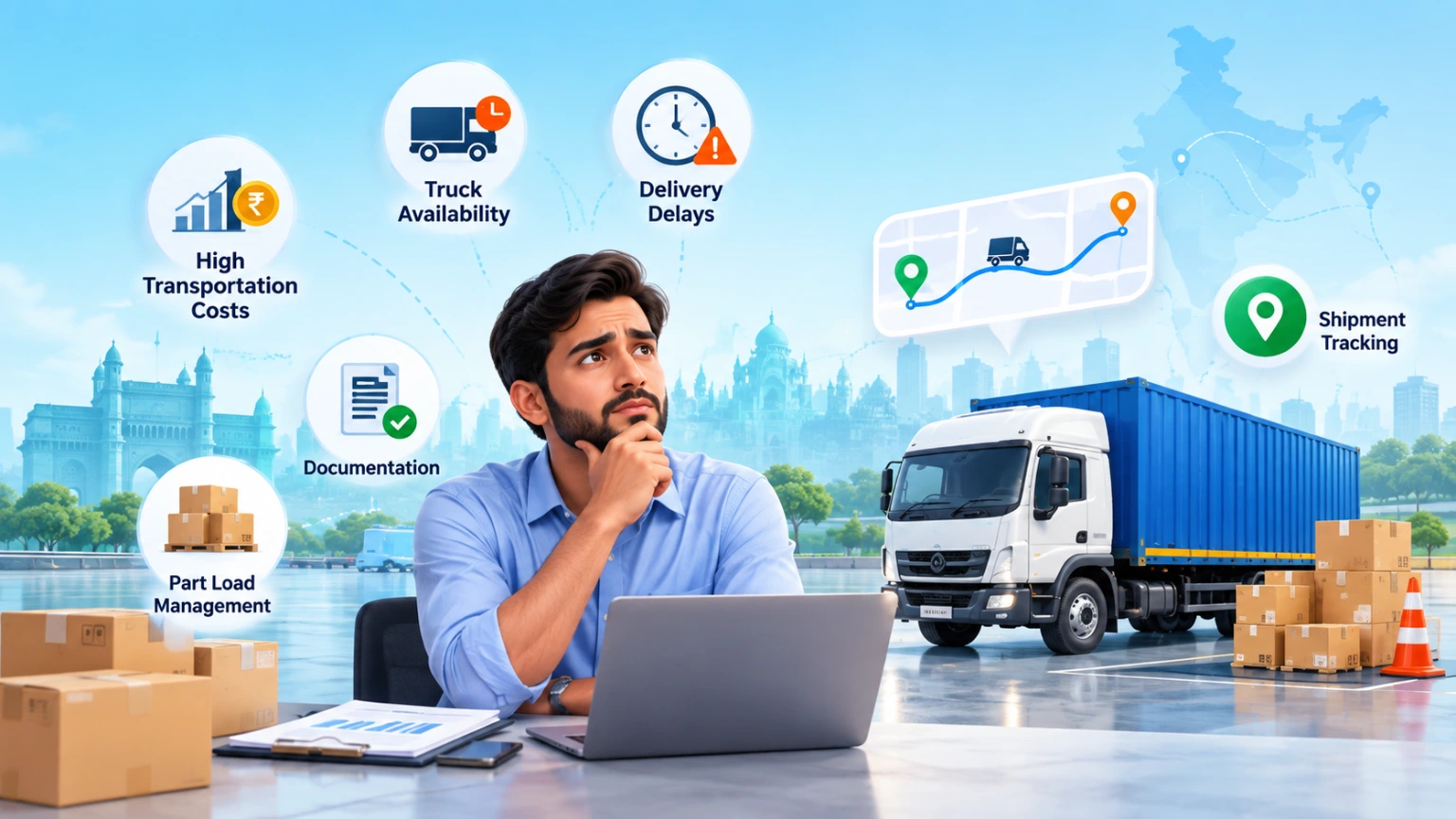
Transportation plays a critical role in the success of small and medium-sized enterprises (SMEs) in India. Whether a business is transporting raw materials to a factory, sending finished goods to distributors, or delivering products to customers across cities, reliable transportation directly affects cost, delivery commitments, and customer satisfaction.
For many SMEs, however, managing transportation is not simple. Finding the right truck at the right time, controlling freight costs, tracking shipments, handling part-load consignments, and dealing with unexpected delays can consume significant time and resources.
Here are 10 major transportation challenges faced by SMEs in India and practical ways businesses can address them.
1. Finding the Right Truck at the Right Time
One of the most common transportation challenges for SMEs is truck availability.
Businesses may need different vehicles depending on shipment size, weight, product type, and destination. A company might require a small commercial vehicle for a local shipment today and a larger truck for an interstate shipment tomorrow.
During peak seasons, festivals, month-end dispatches, or periods of high market demand, finding a suitable truck can become even more difficult.
How SMEs Can Address It
Instead of depending on a limited number of transporters, businesses can use technology-enabled transportation platforms that provide access to different truck types and transportation options.
This helps businesses choose vehicles according to their actual shipment requirements.
2. High and Unpredictable Transportation Costs
Transportation expenses can form a significant part of an SME’s operating costs.
Freight rates can change due to factors such as:
- Fuel prices
- Route and distance
- Truck availability
- Shipment weight and volume
- Seasonal demand
- Toll charges
- Loading and unloading requirements
- Waiting or detention time
When transportation costs are unpredictable, SMEs may find it difficult to calculate product margins and plan their logistics budgets accurately.
How SMEs Can Address It
Businesses should maintain historical freight data for their frequently used routes and compare transportation options before booking.
Selecting the correct truck size is equally important. Booking a truck significantly larger than required may result in paying for unused capacity.
For smaller shipments, Part Load (PTL) transportation can sometimes be more economical than booking an entire truck.
3. Difficulty Managing Part-Load Shipments
Not every SME has enough goods to fill an entire truck.
Suppose a business needs to transport only 2 tonnes of material from Ahmedabad to Mumbai. Booking a full truck when only a portion of its capacity is required can increase transportation costs.
This creates an important decision:
Should the business wait for more goods or pay for a full truck?
Neither option may be ideal when the shipment is time-sensitive.
How SMEs Can Address It
Part Load transportation allows multiple consignments to share available truck capacity.
Businesses pay for the capacity they require rather than unnecessarily booking an entire vehicle.
For SMEs with frequent smaller shipments, this can help improve transportation efficiency and reduce freight expenses.
Related Service: Part Load Transport Service
4. Lack of Shipment Visibility
Once a truck leaves the warehouse, businesses want answers to simple questions:
- Where is my shipment?
- Has the truck crossed the expected location?
- When will it reach the customer?
Without proper tracking, logistics teams often depend on repeated phone calls to drivers or transporters for updates.
This becomes particularly difficult when a company manages multiple shipments simultaneously.
How SMEs Can Address It
Digital transportation systems with shipment tracking can provide better visibility throughout the journey.
Improved visibility helps businesses monitor deliveries, communicate realistic ETAs to customers, and respond more quickly when delays occur.
5. Delivery Delays
Delayed deliveries are one of the biggest concerns in road transportation.
A truck may be delayed because of:
- Traffic congestion
- Road conditions
- Weather
- Vehicle breakdowns
- Loading delays
- Unloading delays
- Route restrictions
- Documentation issues
- Unexpected operational problems
Even when the delay is outside the SME’s direct control, the customer usually expects the seller to provide an explanation and updated delivery timeline.
How SMEs Can Address It
Businesses should plan realistic transit times instead of promising customers the shortest possible delivery time.
Tracking shipments and maintaining proactive communication with customers can also reduce the impact of unavoidable delays.
For critical shipments, businesses should consider additional buffer time when planning dispatches.
6. Choosing the Wrong Vehicle
Choosing the cheapest available truck is not always the most economical decision.
Different goods require different vehicle configurations.
For example, transportation requirements for:
- Machinery
- FMCG products
- Textiles
- Furniture
- Electronics
- Construction materials
- Industrial components
can be very different.
The shipment may require an open truck, closed-body vehicle, container truck, small commercial vehicle, or another configuration depending on the cargo.
How SMEs Can Address It
Before booking transportation, consider:
Cargo weight + Cargo volume + Dimensions + Product type + Route + Loading method + Unloading method.
Selecting a suitable vehicle can reduce unused capacity, unnecessary transportation costs, and the risk of cargo damage.
7. Damage and Safety of Goods
Cargo damage can directly affect an SME’s profitability and customer relationships.
Damage may occur because of improper packaging, poor loading practices, unsuitable vehicles, inadequate securing of goods, or rough road conditions.
For fragile or high-value products, even a small handling mistake can result in significant losses.
How SMEs Can Address It
Businesses should establish clear packaging and loading standards based on product type.
Before dispatch, teams should verify that:
- Packaging is appropriate for road transportation
- Goods are properly stacked
- Cargo is securely fastened where required
- The selected truck is suitable for the product
- Shipment documents are complete
Photographs of the loaded goods can also provide useful dispatch records.
8. Complicated Transportation Documentation
Interstate transportation in India can involve multiple documents depending on the shipment and transaction.
These may include:
- Invoice
- E-Way Bill
- LR/Bilty
- Delivery Challan
- Vehicle details
- GST-related information
- Proof of Delivery (POD)
Incorrect or incomplete documentation can create unnecessary delays during transportation.
For SMEs without dedicated logistics teams, managing these requirements for multiple shipments can become difficult.
How SMEs Can Address It
Businesses should create a standard dispatch checklist and verify documentation before allowing a vehicle to leave the pickup location.
Digital storage of transportation documents can also make it easier to retrieve invoices, LR copies, PODs, and other records when required.
9. Too Much Manual Coordination
Many SMEs still manage transportation using phone calls, spreadsheets, WhatsApp messages, and handwritten records.
For a few monthly shipments, this may appear manageable.
As shipment volume grows, however, the logistics team may spend substantial time on:
- Calling transporters
- Negotiating rates
- Finding trucks
- Sharing pickup information
- Tracking drivers
- Asking for delivery updates
- Collecting PODs
- Maintaining freight records
The problem is not only the time spent. Information can also become scattered across different people and communication channels.
How SMEs Can Address It
Digitizing the transportation booking and tracking process can centralize shipment information.
A single system for booking, tracking, shipment history, and documentation can reduce repetitive manual coordination and give management better visibility into logistics operations.
10. Scaling Transportation as the Business Grows
Transportation requirements change as an SME grows.
A business that initially makes a few local deliveries may eventually start supplying products across Gujarat, Maharashtra, Rajasthan, Delhi, Karnataka, and other markets.
With growth comes greater complexity:
More Shipments → More Routes → More Transporters → More Coordination → More Tracking → More Documentation
Managing this expansion entirely through manual processes can become difficult.
How SMEs Can Address It
Businesses should build a scalable transportation process before shipment volumes become difficult to manage.
This includes:
- Standardizing booking procedures
- Maintaining route-wise freight records
- Digitizing shipment tracking
- Maintaining transportation documents centrally
- Monitoring transporter performance
- Using both Full Truck Load and Part Load options according to shipment requirements
A structured logistics process allows an SME to expand into new markets without increasing transportation complexity at the same rate.
How Technology Is Changing Transportation for Indian SMEs
Digital technology is gradually changing how businesses book and manage road transportation in India.
Instead of coordinating every shipment through multiple phone calls, businesses can increasingly use online transportation platforms to manage activities such as:
Truck Booking → Vehicle Selection → Shipment Tracking → Delivery Updates → Transportation Records
For SMEs, the objective is not simply to move transportation online. The bigger benefit is gaining better visibility and control over logistics operations.
A well-designed digital transportation process can help businesses reduce manual coordination, make more informed transportation decisions, and manage growing shipment volumes more efficiently.
How LoadUp Helps Businesses Simplify Transportation
LoadUp provides online truck booking solutions designed to make road transportation easier for businesses across India.
Businesses can use LoadUp for transportation requirements such as:
- Full Truck Load (FTL)
- Part Load (PTL)
- Intercity transportation
- Business and industrial goods transportation
- Different vehicle requirements based on shipment size
For SMEs, having access to both full-truck and part-load options can be particularly useful because transportation requirements can vary significantly from one shipment to another.
Instead of relying entirely on traditional offline coordination, businesses can use a digital transportation platform to simplify the process of arranging and managing their shipments.
Related Services:
Final Thoughts
Transportation is more than moving goods from one location to another. For SMEs, it directly influences operating costs, inventory movement, customer commitments, and the ability to expand into new markets.
Challenges such as unpredictable freight costs, truck availability, shipment tracking, delivery delays, documentation, cargo safety, and manual coordination can become increasingly difficult as a business grows.
The solution is not always to find the cheapest transporter.
Businesses should focus on building a transportation process that is reliable, transparent, flexible, and scalable.
By selecting the right vehicle, using Full Truck Load or Part Load transportation appropriately, improving shipment visibility, and adopting digital transportation tools, Indian SMEs can build more efficient logistics operations and focus more of their resources on growing their core business.
Frequently Asked Questions
What are the biggest transportation challenges faced by SMEs in India?
The major transportation challenges include truck availability, unpredictable freight costs, delivery delays, shipment tracking, cargo safety, transportation documentation, part-load management, and excessive manual coordination.
How can SMEs reduce transportation costs?
SMEs can reduce transportation costs by selecting the correct truck size, comparing transportation options, planning shipments in advance, reducing waiting time, and using Part Load transportation when a shipment does not require an entire truck.
What is Part Load transportation?
Part Load transportation allows goods from multiple customers to share available truck capacity. It can be a cost-effective option for businesses that need to transport smaller quantities of goods.
When should an SME choose Full Truck Load?
Full Truck Load is generally suitable when the shipment is large enough to use most or all of a truck, when a dedicated vehicle is required, or when businesses want to minimize additional handling during transportation.
How does online truck booking help SMEs?
Online truck booking can help SMEs simplify vehicle selection, transportation booking, shipment tracking, and logistics coordination while maintaining better visibility of their transportation activities.